
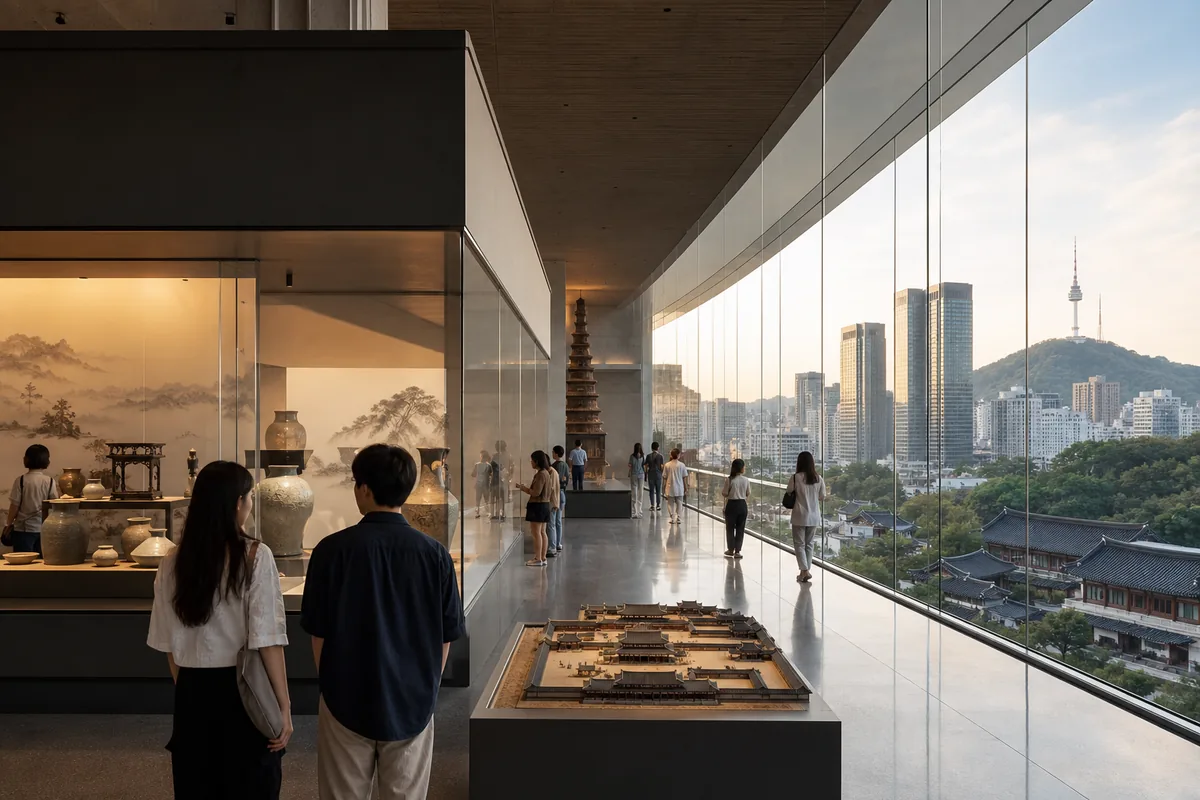
Free Museums in Seoul
Seoul is one of Asia’s most generous cities when it comes to free cultural access, with a network of national and municipal museums that charge nothing for admission. Free museums in Seoul span ancient Korean history, contemporary craft, aviation, language, and urban architecture, many of them housed in striking modern buildings. Whether you are drawn to 5,000 years of Korean heritage or the design-forward spaces of the city’s newer institutions, a full day of free museum-hopping in Seoul is not just possible but genuinely rewarding.
Overview
Our directory lists 10 free museums across Seoul, covering national history, folk culture, contemporary craft, aviation, language, civic memory, urban design, and literature. These institutions cluster around three main zones: the Yongsan-Ichon corridor south of the Han River near Yongsan Station, the Jongno-Jung-gu historic core around Gwanghwamun and the old city center, and the Songpa district in southeastern Seoul near Olympic Park and Lotte World.
South Korea has a strong tradition of free entry at national museums, and Seoul benefits from this more than any other Korean city. Most major national institutions are open six days a week (closed Mondays or specific holidays), and several offer English-language audio guides or signage. The city’s excellent subway system makes it simple to connect museum clusters with minimal travel time.
Top Always-Free Picks
-
National Museum of Korea (국립중앙박물관) — The crown jewel of Korean museums and one of the largest in Asia, the National Museum of Korea sits on a vast campus in Yongsan. Its permanent galleries trace Korean history from the Paleolithic era through the Joseon dynasty, with highlights including Silla-era gold crowns, celadon ceramics, and Buddhist sculptures. The building itself is monumental, and the surrounding grounds include reflecting pools and views toward Namsan Tower. Plan at least two to three hours here.
-
National Folk Museum Children’s Museum — Located on the grounds of Gyeongbokgung Palace in the Jongno historic core, this museum is designed for young visitors but charming for all ages. Interactive exhibits bring traditional Korean folk life to vivid reality, from hanok village models to hands-on craft activities. It is an ideal stop for families and sits just steps from the main National Folk Museum (which is also free with palace admission).
-
Seoul Museum of Art (SeMA) - Nam-Seoul branch — Housed in a converted Belgian-style building in Gwanak-gu, the Nam-Seoul branch of SeMA stages rotating contemporary art exhibitions in an architecturally distinctive setting. The programming tends toward emerging Korean and international artists, and the surrounding park makes for a pleasant walk before or after your visit. Free admission applies to most exhibitions.
-
Seoul Museum of Craft Art (서울공예박물관) — One of Seoul’s newest cultural institutions, the Craft Museum opened in Jongno-gu near Anguk Station and is dedicated entirely to Korean and international craft traditions. Galleries cover ceramics, textiles, metalwork, woodcraft, and contemporary design objects across multiple renovated hanok-style buildings. The museum shop and courtyard garden are highlights in their own right.
-
National Aviation Museum (국립항공박물관) — Situated near Gimpo Airport in western Seoul, this museum chronicles the history of Korean aviation from its earliest days through the jet age. Full-scale aircraft, flight simulators, and multimedia displays make it especially engaging for aviation enthusiasts and children. The rooftop observation deck offers views of planes landing and taking off at Gimpo.
-
National Hangeul Museum (국립한글박물관) — Adjacent to the National Museum of Korea in Yongsan, the Hangeul Museum celebrates the Korean alphabet, one of the most scientifically designed writing systems in the world. Exhibits trace the creation of Hangeul by King Sejong in the 15th century and its evolution into the modern script. Interactive displays let visitors try their hand at calligraphy and typesetting. Even non-Korean speakers will find the design and linguistics fascinating.
-
Kim Koo Museum and Library (백범김구기념관) — Dedicated to Kim Koo, one of the most revered figures of the Korean independence movement, this museum in Yongsan tells the story of Korea’s struggle against Japanese colonial rule. Exhibits include personal artifacts, historical documents, and immersive narrative displays. The surrounding Hyochang Park, where several independence activists are buried, adds solemnity and context to the visit.
-
Hanseong Baekje Museum (한성백제박물관) — Located in Olympic Park in the Songpa district, this museum explores the Baekje Kingdom, which had its capital in the area now occupied by southeastern Seoul nearly 2,000 years ago. Archaeological finds from nearby burial mounds and fortress sites are displayed alongside reconstructions of Baekje-era life. The museum’s modern architecture and the adjacent parkland make it a rewarding half-day destination.
-
Seoul Hall of Urbanism and Architecture — Sitting on Sejong-daero near City Hall, this compact museum examines how Seoul has been planned, built, demolished, and rebuilt over the centuries. Scale models of the city, interactive planning exhibits, and rotating displays on urban issues make it a must for architecture and urbanism fans. Free entry and a central location make it easy to combine with nearby historic sites.
-
Songpa Book Museum — A quieter, more contemplative stop in the Songpa district, this museum is devoted to the history and culture of books and reading in Korea. Exhibits cover printing technology, bookbinding, and the role of literature in Korean society. It pairs naturally with the Hanseong Baekje Museum in the same district for a full southeastern Seoul itinerary.
Best Free Days and Seasons
Seoul’s free museums are open year-round, but seasonal factors shape the experience significantly.
Best months: April through May (spring) and September through November (autumn) offer the most comfortable weather and the best conditions for walking between museums. Cherry blossom season in early April and the fall foliage in late October are particularly beautiful around museum campuses like Yongsan and Olympic Park.
Worst months for crowds: Summer (July-August) brings school holidays and intense heat and humidity, making outdoor walking between sites exhausting. January and February are bitterly cold, though museums are comfortably heated inside.
Best days of the week: Most national museums close on Mondays (or the first Monday of the month). Tuesday through Thursday are the quietest visiting days. Weekends, especially Saturdays, draw large Korean family crowds to the National Museum of Korea and the Craft Museum.
Holiday considerations: Korean public holidays such as Chuseok (harvest festival, usually September-October) and Seollal (Lunar New Year, usually January-February) can cause closures or adjusted hours. Major museums typically stay open during these holidays but with higher attendance. Golden Week-equivalent travel periods in May also spike crowds.
Walking Routes and Clusters
Route 1: Yongsan-Ichon Museum Mile (Half Day)
Start at the National Museum of Korea, allowing two to three hours for the permanent galleries. Walk five minutes east to the National Hangeul Museum on the same campus. After exploring Hangeul, walk or take a short taxi ride (about 10 minutes) northwest to Hyochang Park and the Kim Koo Museum and Library.
Transit tip: Take Metro Line 4 or the Gyeongui-Jungang Line to Ichon Station (Exit 2). A well-marked pedestrian path leads directly to the National Museum campus. This route covers three museums within a roughly 2-kilometer radius.
Route 2: Jongno Historic Core (Half Day)
Begin at the Seoul Museum of Craft Art near Anguk Station. After exploring the craft galleries and courtyard, walk 10 minutes northwest into the Gyeongbokgung Palace grounds to visit the National Folk Museum Children’s Museum. From there, walk south along Sejong-daero (about 15 minutes) to the Seoul Hall of Urbanism and Architecture near City Hall.
Transit tip: Take Metro Line 3 to Anguk Station (Exit 1). This route stays within the walkable Jongno-Jung-gu historic zone. Along the way you will pass Gwanghwamun Square, Cheonggyecheon Stream, and several Joseon-era landmarks, all free to enjoy.
Route 3: Songpa and Southeast Seoul (Half Day)
Start at the Hanseong Baekje Museum inside Olympic Park in Songpa. After exploring Baekje-era artifacts, stroll through the park to the Songpa Book Museum. Olympic Park itself is a sprawling green space with outdoor sculptures and walking paths, so allow time to enjoy the surroundings between museum stops.
Transit tip: Take Metro Line 8 to Mongchontoseong Station (Exit 1), which places you at the Olympic Park entrance. The two museums are roughly 15 minutes apart on foot within the park grounds.
Planning Tips
- Language: Major national museums (National Museum of Korea, Hangeul Museum, National Aviation Museum) have excellent English signage and often offer free English audio guides. Smaller municipal museums may have limited English, so downloading a translation app like Papago is helpful.
- Hours: Most Seoul museums open at 10:00 AM and close between 5:00 and 6:00 PM. The National Museum of Korea stays open until 9:00 PM on Wednesdays and Saturdays, making evening visits possible. Always check holiday schedules, as closures can shift around Chuseok and Seollal.
- Accessibility: National museums in Seoul generally offer strong accessibility, including wheelchair ramps, elevators, accessible restrooms, and loaner wheelchairs at information desks. The subway system is mostly accessible, though some older stations lack elevators. Check the specific museum’s website for detailed accessibility information.
- What to bring: Comfortable walking shoes are essential, as museum campuses can be sprawling. In summer, carry water and a portable fan. In winter, dress in warm layers, as you will be moving between heated interiors and cold outdoors. A T-money transit card (available at any convenience store) simplifies subway and bus travel.
- Budget tips: Museum cafeterias at the National Museum of Korea and the Craft Museum offer affordable Korean meals. Street food near Gwanghwamun and convenience stores (GS25, CU, 7-Eleven) throughout the city provide cheap, filling options. Avoid eating inside tourist zones like Myeongdong when possible.
- Photography: Photography is generally allowed in permanent collection galleries but restricted in special exhibitions. Always look for signage at gallery entrances. Selfie sticks may be prohibited in some spaces.
Keep Exploring
Explore more free museums in Seoul
Interested in free museums elsewhere in Asia? Browse our guide to free museums in Tokyo for another day of no-cost culture.
FAQ
-
Q: Are these museums always free? All 10 museums listed here offer free general admission to their permanent collections. Some may charge for special temporary exhibitions, but the core galleries are always free. Check each museum’s website before visiting for the latest information on any ticketed shows.
-
Q: Do I need to make a reservation? Most Seoul museums do not require advance reservations for free general admission. However, the National Museum of Korea may implement timed entry during peak periods or blockbuster exhibitions. It is worth checking the museum’s website or the online reservation system (if available) before your visit, especially on weekends.
-
Q: What is the best time to visit free museums in Seoul? Tuesday through Thursday mornings are the quietest. Spring (April-May) and autumn (September-November) offer the best weather for walking between museum clusters. Avoid major Korean holidays and school vacation periods if you prefer smaller crowds.
-
Q: Are free museums in Seoul accessible for non-Korean speakers? Yes. The major national museums provide English signage, brochures, and often free audio guides. The Seoul Museum of Craft Art and the Seoul Hall of Urbanism and Architecture also have solid English-language support. Smaller museums may have limited English, but a translation app fills most gaps.
-
Q: How do I get between museum clusters using public transit? Seoul’s subway system is fast, affordable, and well-signed in English. The Yongsan-Ichon cluster is on Line 4 and the Gyeongui-Jungang Line. The Jongno historic core is served by Lines 1, 3, and 5. The Songpa cluster is on Line 8. A single ride costs around 1,400 KRW (about $1 USD) with a T-money card.
-
Q: Can I visit all 10 museums in one day? It would be extremely rushed. The National Museum of Korea alone warrants two to three hours. A more realistic plan is to tackle one cluster per half-day, covering two or three museums comfortably. Over two full days, you could visit all 10 museums with time to enjoy the neighborhoods and meals in between.